

-
RSS feed
Categories
Retail Management Supplements
-
Recent Posts
Archives
Twitter Updates
Tweets by BEretail
Using Prices as a Segmentation Tool
Mark Stiving, writing for Upstream Commerce, offers a lot of useful tips for using prices as differentiators for different shoppers.
Here are some highlights from a recent Stiving article:
“Are you tracking what each customer buys? Are you using that data analysis to help you define and offer discounts? If not, you should be.”
“Search your data to find two items that many people buy together. Then, when someone who historically only buys one of these items comes back to the store, offer them a discount for the other.”
“Search your data for people who intermittently buy some quantity of a product. Offer them a discount if they buy double the amount.”
“Identify customers who usually buy a specific brand of a product. Sell the ‘ability’ to a competing brand, to offer a discount. For example, if someone usually buys Lay’s potato chips, Pringle’s might pay to offer a discount to entice customers to switch.”
“Every business is different, but the lesson for segmentation is start with the ‘right’ price, then offer discounts for acceptable reasons, such as loyalty – try to get them to buy more of one item, get them to sample a related product, or to try a similar, but competing item.”
Click the image for Stiving’s full article.

Kindlemania?
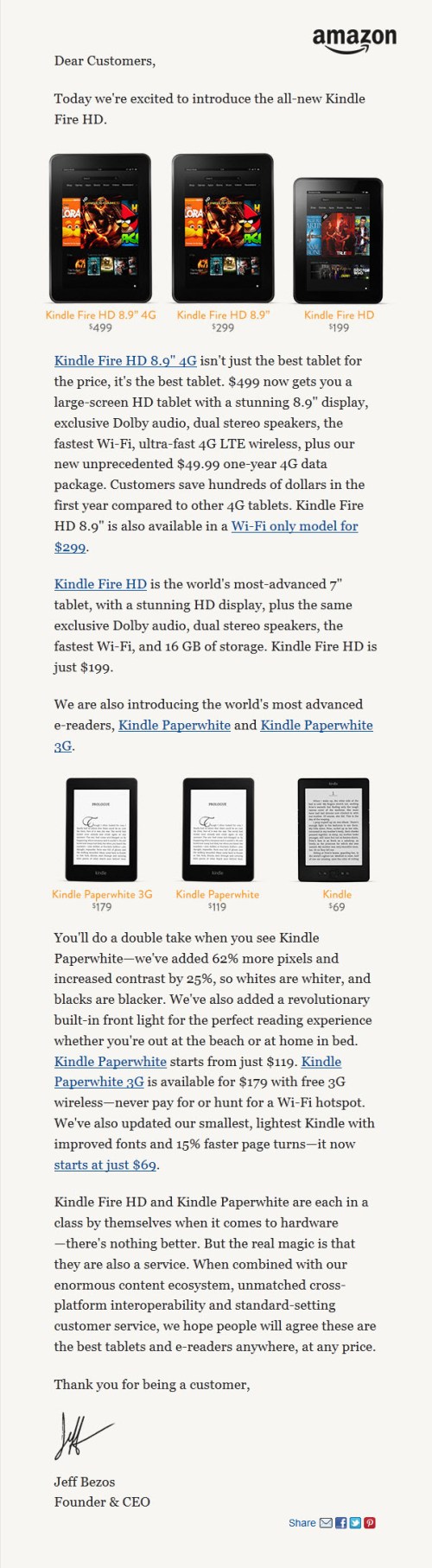
This week, Amazon made a major announcement of a new series of Kindle Fires and Kindles through the media and at its Web site. And NPD offered its take on this. Read the announcement and the commentary beneath it.
After analyzing the announcement, NPD (the marketing research firm) commented on four issues at its blog: “The first is that, for the most part, the product line expanded upward in price and feature. Instead of offering aggressive absolute prices, Amazon is now choosing to compete by offering more, features, content, and services at equivalent price points to the competitors. Second is the decision to move to an 8.9” screen and put Bluetooth on-board most SKUs [versions]. This should allow a blossoming of the availability of new accessories and a significant growth in the ‘Made-for-Kindle’ business that Amazon has been tentatively exploring. The third interesting point for us is Amazon’s decision to create so many new SKUs [versions] differentiated only by storage amounts. Finally is distribution. Like the original Fire and the Kindle E-readers, Amazon has committed to using retail distribution [stores] to supplement their own Web site sales, a continuing tacit admission that the reach and presence of retail [stores] is necessary to be competitive with other products in the tablet market.”
Click the image to access NPD’s full blog post.

Posted in Online Retailing, Part 1: Overview/Planning, Part 2: Ownership, Strategy Mix, Online, Nontraditional, Part 3: Targeting Customers and Gathering Information, Part 5: Managing a Retail Business, Part 6: Merchandise Management and Pricing, Part 7: Communicating with the Customer, Social Media and Retailing
Tagged Amazon, Apple, competition, customer expectations, customer service, experiential retailing, iPad, Kindle Fire, location, merchandising, online shopping, opportunity, technology, trends
1 Comment


