Understanding Shopping Cart Abandonment

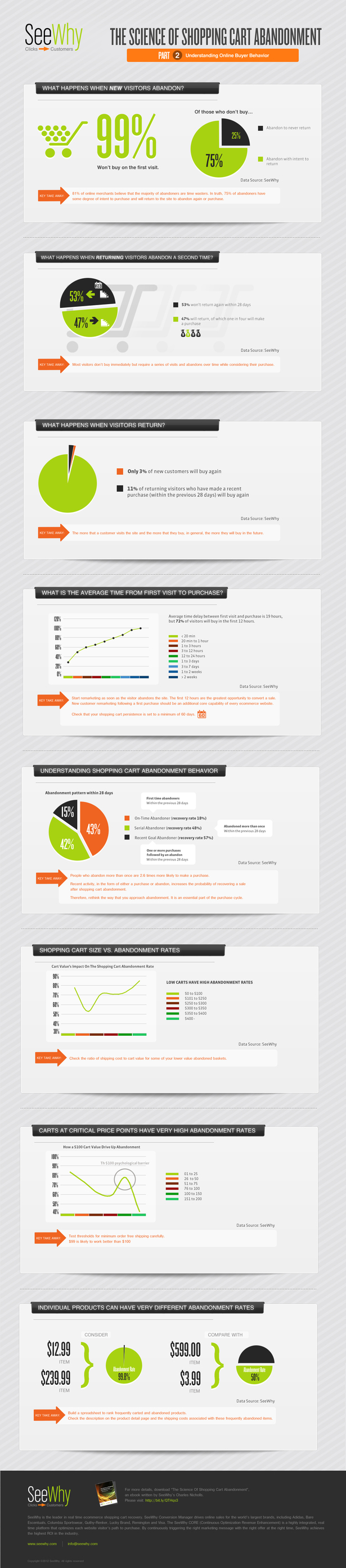
Shopping cart abandonment is a HUGE problem that online retailers must address (see this post, for example).
As Erin Lynch reports for Multichannel Merchant: “Shopping cart abandonment is a major E-commerce concern, especially when nearly 72% of Web site visitors add items to their carts but never complete their purchase. In the infographic below from SeeWhy, you will learn about the buying behaviors of new shoppers, what happens when regular customers abandon their carts for a second time, and of those who return to your site is actually going to buy again.”


Posted in Online Retailing, Part 3: Targeting Customers and Gathering Information, Part 5: Managing a Retail Business, Part 6: Merchandise Management and Pricing, Part 7: Communicating with the Customer | Tagged , , , , , , , , , , , | 1 Comment

Cabela’s Multi-Channel Approach

Cabela’s is one of the foremost multi-channel outdoor outfitters in the world — with mail-order, retail store, and Internet operations.
As Tracey Ryniec reports for Forbes:
“Cabela’s is more than just a retailer that sells hunting, fishing, and camping merchandise. It only has 35 stores in the U.S. and Canada but customers have been known to drive vast distances to go to a store. The larger legacy stores are built like large log cabins and have unique features such as in-house restaurants – some which serve wild boar – trophy animal mounts displayed on indoor mountains, and big aquariums filled with fish. You don’t just go to Cabela’s to shop. You go there for the experience. When a new store opens, it’s a big event. It’s not unusual to see 10,000 to 15,000 people show up at a grand opening.”
“Cabela’s is focusing on bringing the store experience to customers who don’t have one nearby and aren’t willing to drive to one. It has a bunch of initiatives to improve its online experience, which it will start instituting this year. Cabela’s foresees itself rolling out 10 to 12 new stores a year and is focusing on opening stores where online sales and catalog orders are the strongest. That’s why it will be opening its first store in the Southeast in South Carolina and its first in Alaska in 2014.”
Click the image to read more from Ryniec.


Posted in Online Retailing, Part 1: Overview/Planning, Part 2: Ownership, Strategy Mix, Online, Nontraditional, Part 3: Targeting Customers and Gathering Information, Part 4: Store Location Planning, Part 5: Managing a Retail Business, Part 6: Merchandise Management and Pricing, Part 7: Communicating with the Customer, Part 8: Putting It All Together | Tagged , , , , , , , , , , , , | Leave a comment

Larger Retailers Having Trouble in India

As the world’s second-largest market in the world, India has been attracting a number of foreign retail chains. While some are succeeding, others have had a tough time. The “mom-and-pop” store remains extremely popular in India.
Here is a recent example. It involves the inability of stationery chains to flourish in India. According to Rasul Bailay, writing for the Economic Times:
“The legions of tiny neighborhood stores selling pencils, staplers, and other stationery may be oblivious to it, but they are forcing multinational stationery retailers that have ventured into the country to shut shops, sell out, or change strategies. Reliance Retail is folding up all four retail stores of American office supply chain Office Depot, while Staples. Inc is in the process of selling most of its 49% stake in its cash-and-carry joint venture with Future Group. Prior to that, a third U.S. stationery retailer, Office 1 Superstore International shut its India franchisee operations run by New Delhi-based Indo Rama Group.”
“Experts say India’s consumer stationery market is ruled by tiny stationers in crowded neighborhood bazaars, and consumers don’t seem particularly keen to buy stationeries from branded stores in malls.”
Click the image to read more from Bailay.


Posted in Global Retailing, Part 1: Overview/Planning, Part 2: Ownership, Strategy Mix, Online, Nontraditional, Part 3: Targeting Customers and Gathering Information, Part 4: Store Location Planning, Part 5: Managing a Retail Business, Part 6: Merchandise Management and Pricing, Part 7: Communicating with the Customer, Part 8: Putting It All Together | Tagged , , , , , , , , , , , , | Leave a comment