Amazon Collecting Sales Tax in More States

Since their inception, online retailers have often had a major advantage over their brick-and-mortar and brick-and-click counterparts: they haven’t had to collect sales tax on items sold to customers in many states where they did not have a physical presence.
This practice has harmed two parties: retailers with stores that must collect sales tax, thereby making their prices higher than online retailers; and states that have not received sales tax revenues from purchases made online by people in those states.
After new laws and litigation, Amazon.com is one online retailer that collects sales tax in most states.  As Matt O’Brien recently for the Associated Press:
“Many online shoppers in the United States have for years had to pay state sales taxes whenever they buy goods from Amazon. But the E-commerce giant has dragged its feet on collecting sales taxes in small states where it doesn’t have any distribution centers or corporate offices. That’s changing this year.  Amazon customers in at least 10 more states will begin paying sales taxes on their online purchases for the first time this winter: Iowa, Louisiana, Mississippi, Missouri, Nebraska, Rhode Island, South Dakota, Utah, and Vermont. It already started this month in Louisiana, Iowa, Nebraska, Utah, and Wyoming.”
“The move follows December 2016’s U.S. Supreme Court ruling that rejected a challenge to a Colorado law requiring online sellers to notify customers about how much they owe in taxes. To avoid collecting taxes, Amazon has historically relied on another high court ruling that predates the era of online shopping. That 1992 decision bans states from forcing out-of-state retailers to collect taxes if they don’t have a physical presence in the state.”
“Excluding states that don’t have a sales tax, only 6 states remain where Amazon doesn’t collect sales taxes or hasn’t announced plans to do so. “


Click the image to read more.


Posted in Online Retailing, Part 1: Overview/Planning, Part 2: Ownership, Strategy Mix, Online, Nontraditional, Part 3: Targeting Customers and Gathering Information, Part 5: Managing a Retail Business, Part 6: Merchandise Management and Pricing | Tagged , , , , , , , , , , | 2 Comments

Don’ts for Retailers Using Social Media

In this new era of fake news, alternative truth, and inflammatory messages on social media, it is a good time for us to appraise (or reappraise) our own use of social media. Are we doing the best we can to avoid careless mistakes or inflammatory language?
Recently, Annie Pilon described “20 Taboo Topics to Stay Away from on Your Company’s Social Media Channels” for Small Business Trends. Here are some of her observations. PLEASE keep them in mind when utilizing social media and reacting to comments by others:
“If you use social media to promote your business online, you’ve probably put a lot of thought into what types of posts to share. But sometimes it can be just as important to consider what NOT to post on social media.”
                “Making fun of specific groups of people can go too far.
Even the occasional complaint about customers can be enough to damage your brand.
Avoid complaining about your employees online.
Customers want to know that you have a team that they can trust.
Nonconstructive criticism about public figures can seem petty to your social media followers.
You don’t want to be too intrusive when asking questions of your followers.
Be careful not to share anything that’s not true, as it can make your business look bad and lead to your followers being misinformed.
Healthy competition can be good for a business, even on social media. But there’s a big difference between a friendly back-and-forth and trash-talking.
Social media also isn’t the place to share sensitive or confidential information about customers.
Don’t share with followers every time you’re having a bad day or just feeling ‘blah’ about your business.
Posting anything illegal, whether it’s drug use or even just speeding, is a very bad idea.
Stay away from sharing any content that could be considered controversial.
It’s also best not to post anything that’s irrelevant to your audience.”


Click the image to learn more from Pilon.


Posted in Global Retailing, Online Retailing, Part 1: Overview/Planning, Part 2: Ownership, Strategy Mix, Online, Nontraditional, Part 3: Targeting Customers and Gathering Information, Part 7: Communicating with the Customer, Privacy and Identity Theft Issues, Social Media and Retailing | Tagged , , , , , , , , , , , , , , , , | Leave a comment

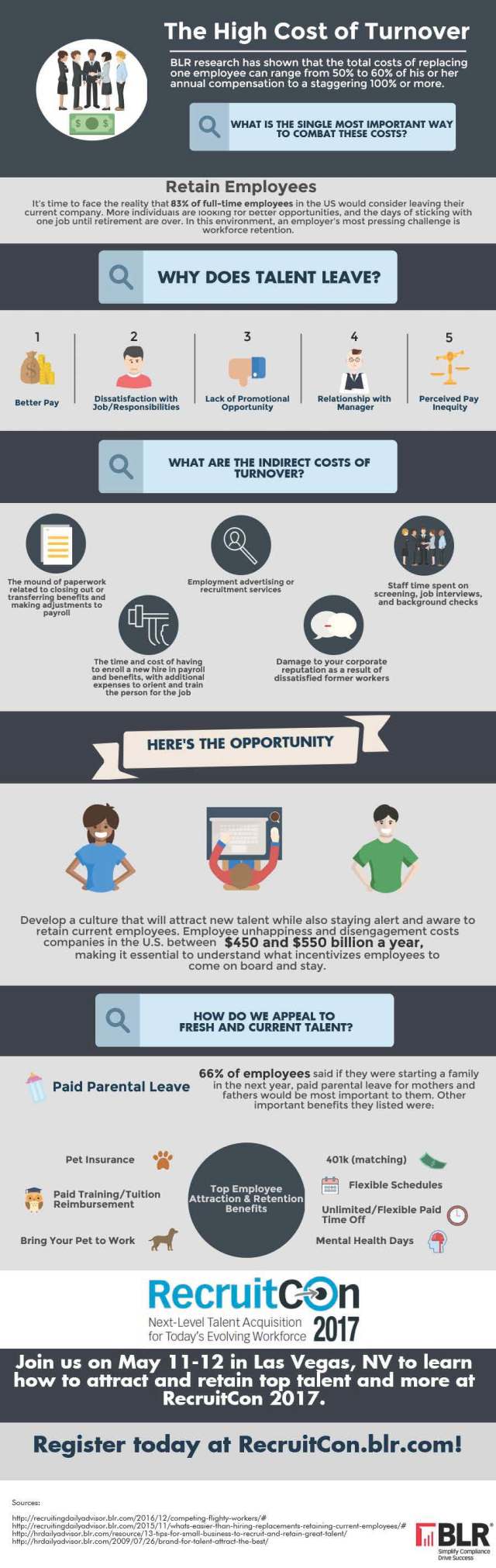
Employee Turnover in Retailing: An Infographic

Employee turnover is a big issue for many retailers, regardless of their size. In the United States, including only data reported to the Bureau of Labor Statistics, the retail sector has had monthly employee separations in 2015-2016 ranging from 571,000 to 1,016,000.
Take a look at some of the costs and opportunities with regard to retail employee turnover as reported by BLR.con.

 
high-cost-of-turnover-how-to-retain-employees
 

Posted in Career Useful Information, Careers in Retailing, Part 1: Overview/Planning, Part 2: Ownership, Strategy Mix, Online, Nontraditional, Part 3: Targeting Customers and Gathering Information, Part 5: Managing a Retail Business, Part 7: Communicating with the Customer, Part 8: Putting It All Together | Tagged , , , , , , , | 2 Comments