

-
RSS feed
Categories
Retail Management Supplements
-
Recent Posts
Archives
Twitter Updates
Tweets by BEretail
Dealing with an Ominchannel Shopping Experience
Posted in Online Retailing, Part 1: Overview/Planning, Part 2: Ownership, Strategy Mix, Online, Nontraditional, Part 3: Targeting Customers and Gathering Information, Part 4: Store Location Planning, Part 5: Managing a Retail Business, Part 6: Merchandise Management and Pricing, Part 7: Communicating with the Customer, Part 8: Putting It All Together
Tagged customer expectations, customer service, experiential retailing, location, merchandising, multichannel, omni channel, online shopping, opportunity, planning, tips
2 Comments
The State of U.S. Shopping Centers
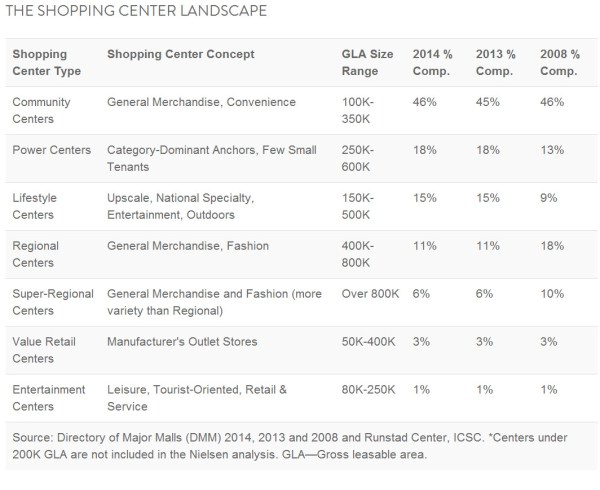
Shopping centers remain very popular in the United States — in the face of strong competition from online retailing and stores not located in shopping centers. However, this strength varies by the type of center.
Nielsen reports that:
“According to the 2014 State of the Shopping Center report, the number of large shopping centers (200K+ gross leasable area {GLA}) grew by 3 percent in the past year. Community centers, which feature neighborhood-serving amenities like grocery stores and dry cleaners, are still the most common type of shopping center in 2014, comprising 46 percent of centers. In 2013, Nielsen reported the rise of lifestyle centers and the decline of traditional malls like regional and super-regional centers. This trend is holding true in 2014 as consumers continue to be drawn to the shopping experience offered by lifestyle centers with their mix of retail, restaurants and entertainment options.
Nielsen also looked at the expansion of retail chains by category: “Bigger isn’t always better. Since the start of the Great Recession at the end of 2007, small formats like dollar stores, convenience stores and drug stores have driven retail chain expansion. Of the nearly 17,000 new stores that opened between 2007 and 2013, 36 percent were dollar stores, 32 percent were convenience stores and 21 percent were drugstores.”

Involved with Global E-Commerce? Localize!
Just as many retailers tailor their domestic offerings by geographic area, so too must retailers tailor their offerings in a global strategy. This is just as true of E-tailing as it is of store-based retailing.
As Shannon Zimmerman reports for Multichannel Merchant:
“The global market is open for business, and many of your competitors are already out there solidifying their localization strategy for online shoppers. E-commerce provides many opportunities for businesses, but you have to make sure you’re on top of your game.”
Zimmerman offers four tips:
-
Be aware of global shopping events: “Have you heard of a shopping event that generated $5.7 billion online, more than any other national shopping event globally? It’s not Black Friday or Cyber Monday. It’s called Single’s Day in China.
-
Use the native languages of foreign customers: “A solid localization strategy incorporates multiple languages on Web sites. According to a study by Common Sense Advisory, you limit yourself to one third of a potential $45 trillion economic opportunity if your Web sites are only available in English.”
-
Make it easy for customers to make comments: “Customer reviews help boost E-commerce sales, and sites with just product descriptions – even if they have the best content in the local language – can limit conversions. Providing ways for customers to rate and review your products in their own language boosts buyer confidence.”
-
Participate in M-commerce: “The integration of mobile apps – a major trend – into your localized Web site is another important consideration.”
Click the image to read more.

Posted in Global Retailing, Online Retailing, Part 1: Overview/Planning, Part 2: Ownership, Strategy Mix, Online, Nontraditional, Part 3: Targeting Customers and Gathering Information, Part 4: Store Location Planning, Part 5: Managing a Retail Business, Part 6: Merchandise Management and Pricing, Part 7: Communicating with the Customer, Part 8: Putting It All Together
Tagged competition, customer expectations, customer service, experiential retailing, localization, opportunity, planning, tips
3 Comments


