Retailers Need to Do Better with Loyalty Programs

As we have reported before (click here, for example), the quest for customer loyalty continues to be both a critical goal and a major challenge for companies of all types and sizes. Given the importance of customer loyalty, why don’t more firms do a better job with their loyalty programs?

According to eMarketer:

“Firms invest heavily in loyalty programs — a key part of their growth strategy to hook today’s fickle and disloyal consumers. More than four-fifths of consumers said such programs make them more likely to continue business with brands; two-thirds said they modify spending to maximize loyalty benefits; and nearly three-quarters said they would recommend brands with good programs, according to a recent Bond Brand Loyalty study, in partnership with Visa. (The annual study covered 400+ loyalty programs across industries and surveyed over 28,000 North American consumers who participate in at least one program, most in the U.S.)”

“However, the study also suggested that many marketers may not have gotten their loyalty programs right. While the number of loyalty memberships each American consumer belongs to has risen each year to 14+ from under 11 in 2014, the number of programs that consumers remain active in has declined to under 7 from about 8 in 2014. Only 22% of loyalty members feel their brand experience is better than that of non-member. With personalization being a big buzzword, only a quarter of loyalty members said they are happy with the level of personalization experience, the study found.”

 
Click the image to learn more.


Posted in Part 2: Ownership, Strategy Mix, Online, Nontraditional, Part 3: Targeting Customers and Gathering Information, Part 6: Merchandise Management and Pricing, Part 7: Communicating with the Customer | Tagged , , , , | Leave a comment

Supermarket Chains and Social Media

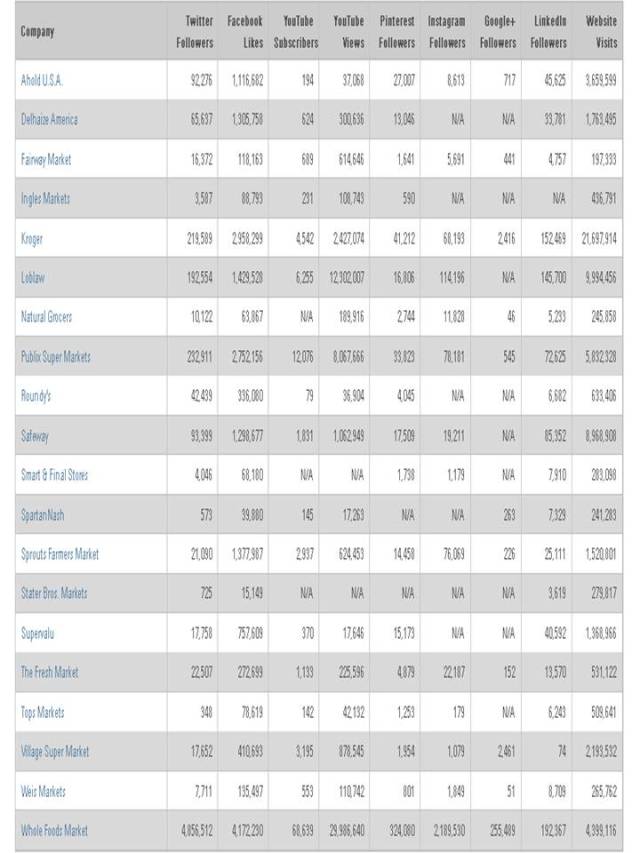
Are supermarket chains active users of social media? There are two important answers to this question: (1) Overall, much more than many observers probably think. (2) There is a wide disparity of use by company and by social media platform.

The eMarketer chart shown below highlights social media involvement for 20 supermarket chains. [Click the image for a larger version of the table.] Whole Foods dominates across platforms!


Here are the leading firms and the 2oth-ranked firms by social media platform engagement:

  • Twitter followers — Whole Foods; Tops
  • Facebook likes — Whole Foods; Stater Bros.
  • YouTube subscribers — Whole Foods; data not available for all 
  • YouTube views — Whole Foods;  data not available for all 
  • Pinterest followers — Whole Foods;  data not available for all 
  • Instagram followers — Whole Foods;  data not available for all 
  • Google+ followers — Whole Foods;  data not available for all 
  • LinkedIn followers — Whole Foods;  data not available for all 
  • Visits to Web site — Kroger; Fairway


Posted in Online Retailing, Part 2: Ownership, Strategy Mix, Online, Nontraditional, Part 7: Communicating with the Customer, Social Media and Retailing | Tagged , , , , | Leave a comment

Here Are Reasons Why Good Stores Succeed

Since retail stores still represent about 90% of U.S. retail shopping, they are not facing imminent death (as some have predicted).

Here are two charts from eMarketer that summarize why and how physical stores retain a lot of popularity, despite consumers’ shifting shopping patterns.

First, how do stores stack up with online retailers? eMarketer notes that:

In-store offerings like easy returns and exchanges, better customer service, and instant gratification trump the online shopping experience for many shoppers, according to market research firm TrendSource.  But online shopping also had advantages, according to the survey. A majority of respondents said that product availability, as well as product variety and selection, were superior on digital platforms when compared with physical store locations.”


Second, eMarketer states that:

“Home improvement and fashion shoppers no longer inherently view online as cheaper. So, retailers should consider creating in-store experiences shoppers value,” TrendSource’s senior director of client and consulting services, said in a statement. Being able to get goods immediately had a strong appeal among those who preferred to make in-store purchases, according to the survey.”


Posted in Part 1: Overview/Planning, Part 2: Ownership, Strategy Mix, Online, Nontraditional, Part 5: Managing a Retail Business, Part 6: Merchandise Management and Pricing, Part 7: Communicating with the Customer | Tagged , , , , | Leave a comment