For Holiday 2014: Will Shippers Be Able to Avoid Last Year’s Problems?

In January, we wrote a post title “Lessons from the Holiday 2013 Hacking and Shipping Fiasco.” That post dealt with the shipping delays by UPS and FedEx so that some shoppers did not get their presents delivered until after Christmas 2013.
To make sure that this big problem does not occur again for the 2014 holiday shopping season, UPS and FedEx have both undertaken a number of initiatives.
UPS is being particularly active in two ways: (1) asking retailers to move up their last dates for guaranteed deliveries of online orders and (2) beefing up its own infrastructure.
FIRST, as Laura StevensSuzanne Kapner, and Shelly Banjo report for the Wall Street Journal:
“UPS is trying to persuade E-commerce companies to hold their big sales in mid-December instead of in the countdown to Dec. 25. It also wants them to stagger special offers geographically — so a GoPro camera might be on sale one day in Texas and a different day in Florida. Perhaps most of all, UPS is lobbying retailers to banish any and all free overnight-shipping offers on Dec. 23, as well as promotional E-mails going out that day.”
“If all else fails, UPS executives say they can’t guarantee they will ship anything that exceeds what retailers projected. UPS CEO David Abney says his company is more focused on providing retailers with options than cutting them off. ‘But,’ he adds, ‘you can’t just encourage everyone to say, ‘Hey, just wait and ship the last day.’”
Click the chart to see a WSJ video.


SECOND, as Mike O’Brien reports for Multichannel Merchant:
“UPS [has] plans for ensuring that delivery issues which plagued the 2013 holiday shopping season aren’t a rerun this year, including a $500 million capital outlay to fund initiatives like a 5% increase in sort capacity and a 10% increase in delivery capacity. Plans also call for use of a mobile distribution center than can be transported across the country by rail, as well as modular additions that can add bays to existing facilities to handle increased demand during peak periods.”
“‘We are ready to deliver, and we’ve been working on it since Dec. 26,[2013]” said Mark Wallace, vice-president of engineering for U.S. domestic operations at UPS. ‘We understand what happened so we have plans in place for 2014.’”
Click the image to read more from O’Brien.

 

Posted in Part 2: Ownership, Strategy Mix, Online, Nontraditional, Part 5: Managing a Retail Business, Technology in Retailing | Tagged , , , , , , , , , , , | 2 Comments

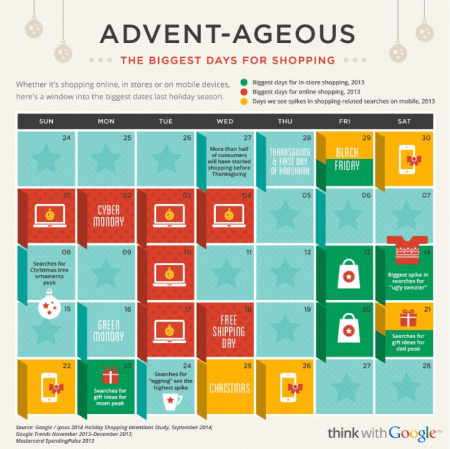
When Do People Do Their Holiday Shopping?

As we enter the 2014 major holiday shopping season — yes, it’s that time already, it is important to understand when consumers will shop.
According to Google:
“This holiday shopping season will be our most connected ever, with devices at our fingertips helping us hunt for deals in short moments. One third of all shopping searches on Google happen between the hours of 10 P.M. and 4 A.M. Today’s shopper spends more time than ever researching purchases online at all hours of the day; we’ve gone from midnight snacking to midnight shopping.”
“We conducted our annual Holiday Shopper Intentions research with Ipsos MediaCT, surveying consumers on their shopping behavior. [We found that] people are starting their research early and retailers are stretching Black Friday promotions across November, changing the focus from just one day to a month-long event. More than half of consumers surveyed said they’ll start their research before Thanksgiving, with 26% of shoppers having started before Halloween.”
Check out this infographic from Google.


Posted in Online Retailing, Part 2: Ownership, Strategy Mix, Online, Nontraditional, Part 3: Targeting Customers and Gathering Information, Part 5: Managing a Retail Business, Part 7: Communicating with the Customer, Social Media and Retailing | Tagged , , , , , , , , , , , , , | 3 Comments

Social Media Use on the Rise for Small and Medium Firms

With the immense popularity of social media, more and more SMBs (small and medium-sized businesses) are now using such media. It’s not just for the big retailers anymore.
According to BIA/Kelsey’s most recent “Local Commerce Monitor” (July 2014), which is ongoing research on the advertising behavior of SMBs), about three-quarters of the firms said they are using social media to promote their businesses — “more than any other category of media.”
BIA/Kelsey reported that:
“Facebook dominates SMB usage, with 55.1 percent of SMBs reporting they have a Facebook page for business use, and 20.0 percent reporting they have run a Facebook ad or promoted post. At the same time, strong showings by other platforms, including LinkedIn, Pinterest, Instagram, and Twitter’s promoted tweets, indicate the social space is highly robust for SMB marketing. SMBs reported spending 21.4 percent of their total media budget on social media in the past 12 months.”
“The survey covers over 35 different media and platforms used by SMBs for advertising and promotion. These media fall into 10 top-level media categories: online (e.g., search, display ads, blogs); traditional (e.g., direct mail, newspapers); mobile (e.g., search, SMS, display); local coupons (print and online); social (e.g., Facebook, Twitter); video (e.g., Web site videos, YouTube); broadcast; local directories (print and online); giveaway items; and community sponsorships.”
Here is an infographic summary.


Posted in Online Retailing, Part 1: Overview/Planning, Part 2: Ownership, Strategy Mix, Online, Nontraditional, Part 3: Targeting Customers and Gathering Information, Part 5: Managing a Retail Business, Part 7: Communicating with the Customer, Social Media and Retailing | Tagged , , , , , , , , , , , , | 1 Comment