Are Retail Pricing Strategies Out of Control?

Recently, we wrote about many restaurants making their menus too complicated, thus leading to significantly slower service and too many choices.
Now, we have a related question: Do some retailers offer too many prices for their product assortment? In many cases, the answer is yes.
As reported by Tom Ryan for RetailWire:
According to a survey by Software Advice, 52 percent of retailers use more than 10 pricing tactics, although most revolve around a strategy of discounting. The study questioned retailers about their experiences with 13 different pricing approaches and found only two percent used two or fewer pricing tactics. The top eight were:”
1. Discount — “Discounts based on either product quantity, customer loyalty or tied to specific promotions.” 2. Bundle — “Multiples of the same product are sold together for a single price, typically lower than purchased individually.” 3. Below competition — “Products priced lower than the closest competitor pricing.” 4. MSRP (manufacturer’s suggested retail price) — “Designed to maintain the manufacturer’s margins and brand perception.” 5. Odd pricing — “Ending prices in odd figures, such as 99 cents, for a psychology play on consumers.” 6. Price lining — “Prices set to create distinct categories of products, signaling a level of quality to the customer.” 7. Dynamic — “Prices change based on the willingness of the customer to pay.” 8. High-low — “Most products are priced above market rate with discounts offered on select items to attract customers.”
Click the image to read more.


Posted in Part 2: Ownership, Strategy Mix, Online, Nontraditional, Part 3: Targeting Customers and Gathering Information, Part 6: Merchandise Management and Pricing | Tagged , , , , , , , , , , | 2 Comments

Ace Hardware: Another Same-Day Delivery Strategy

In recent years, companies such as Google and Amazon have stepped up their same-day delivery efforts — believing that this can be a key competitive advantage for firms with an adequate distribution structure to handle same-day deliveries.
Ace Hardware is one of the most recent entrants into same-day delivery. As Mike O’Brien reports for Multichannel Merchant:
“Ace Hardware has begun a pilot program of same-day delivery via its own associates at 33 stores in select neighborhoods in Florida, Illinois, Colorado, Maryland, Texas, and Arizona. It is an extension of Ace’s in-store pickup program, which is available at more than 1,600 of Ace’s 4,600 U.S. stores. Ace has more than 54,000 SKUs available on acehardware.com, most of which are eligible for same-day delivery if the item is in stock.”
“The program, called Express Delivery, offers same-day delivery of eligible products for a $5 fee to customers within five miles of the participating Ace store when ordered by 1 p.m. local time. Ace plans to test a variety of program components in preparation for a national roll-out. Rival Home Depot began offering same-day delivery in December 2013, while Lowe’s has not as of yet.”
Click the image to read more.


Posted in Part 1: Overview/Planning, Part 2: Ownership, Strategy Mix, Online, Nontraditional, Part 3: Targeting Customers and Gathering Information, Part 4: Store Location Planning, Part 5: Managing a Retail Business, Part 6: Merchandise Management and Pricing | Tagged , , , , , , , , , , | 1 Comment

Encouraging Repeat Business with Frequent-Shopper Programs

TIPS FOR BETTER RETAILING: “Using Frequent-Shopper Programs to Encourage Repeat Business”

by Joel R. Evans and Barry Berman

 
In this post, we continue our discussion about gaining the loyalty and increased patronage of current customers. Our focus is on the value of frequent-shopper programs.
WHAT IS A FREQUENT-SHOPPER PROGRAM? It is one awarding special discounts or gifts to people for their continued patronage. In most such programs, customers must accumulate a certain number of points (or their equivalent); these points are redeemed for cash or prizes. Here are examples: 
  • More than 70 million people belong to the American Airlines’ AAdvantage program. By traveling on American Airlines, and its recently acquired US Airways, and members of American’s One World Alliance – as well as patronizing participating firms such as Marriott and Hertz), people can earn free flights.
  • With Dunkin’ Donuts’ DD Card Perk Rewards Program: “Points will be earned when you use an enrolled DD Card as payment for Qualifying Purchases at participating Dunkin’ Donuts locations. Earn five points for every dollar spent. Every 200 points will get you a Reward Coupon for a free beverage.”
  • The BankAmericard Cash Rewards Credit Card offers online-exclusive $100 cash rewards bonus after a customer spends at least $500 on purchases in the first 90 days of account opening There is 1% cash back on every purchase, 2% at grocery stores, and 3% on gas for the first $1,500 in combined grocery store and gas purchases each quarter. There is no annual fee.
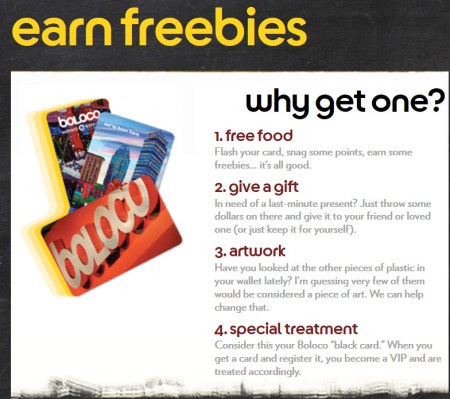
  • Loyalty programs are not just for large firms. Boloco is a small New-England based burrito chain with a very strong customer loyalty program. Customers receive a free item for every $50 spent. This is how the firm promotes the program.
 boloco card
 
Among the advantages of frequent-shopper programs are the loyalty bred (customers can accumulate points only through patronage of one or a few firms), the “free” nature of awards to many consumers, and the competitive edge (distinctiveness) for a firm that is similar to others. Frequent-shopper programs also let existing customers know they are important to the firm and encourage them to shop more often. As a result, a good frequent-shopper program can actually increase the profits of a retailer (rather than decrease them).
Here are several hints with regard to setting up and carrying out an effective frequent-shopper program: 
  • Make the plan easy for people to understand, as well as easy for them to participate.
  • Make the plan easy to administer by the firm.
  • Make sure that points can be redeemed for items which are of value to customers.
  • Do not set the point totals that are needed to gain a benefit from a frequent-shopper program (either a discount or a prize) so high that customers will be frustrated and thereby abandon the program.
  • Have a range of gifts and discounts to encourage higher patronage by current customers. Introduce some new prizes on a regular basis.
  • Run some special promotions that are keyed to frequent-shopper points (such as “Double Points Day”) rather than to run-of-the- mill sales (which everyone else will just copy).
  • Promote the program in and out of the store.
  • Publicize the big award winners. This creates excitement for all.
  • Keep prices competitive so that people do not think they are getting points in exchange for paying higher prices.
  • Constantly re-evaluate the program to see what is working and what is not.


Posted in Part 1: Overview/Planning, Part 2: Ownership, Strategy Mix, Online, Nontraditional, Part 3: Targeting Customers and Gathering Information, Part 5: Managing a Retail Business, Part 6: Merchandise Management and Pricing, Part 7: Communicating with the Customer | Tagged | 2 Comments