Calculating Your Break-Even Point

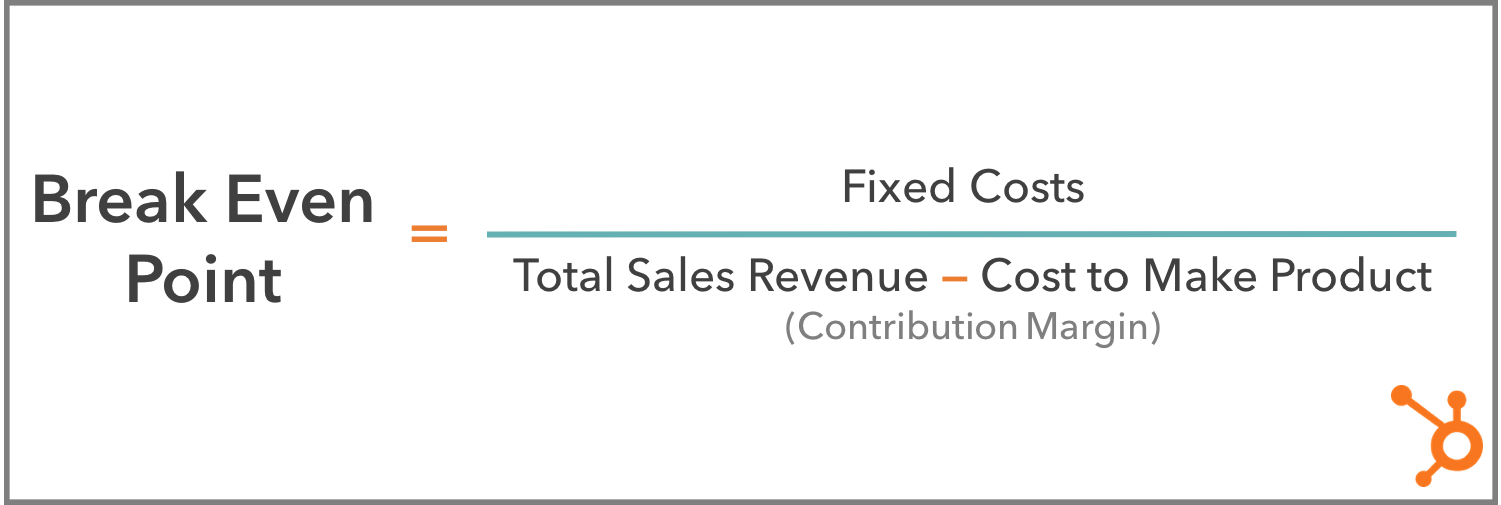
In January, we discussed 2018 Marketing Budget Trends. Today, we examine the basics of calculating your break-even point. This is an important, rather simple metric. But, it is sometimes misunderstand.  

Calculating Your Break-Even Point

According to Braden Becker, writing for HubSpot:

“You’ve heard the term ‘break even.’ It’s a popular way to describe a time when you spent exactly as much money as you made. But in a business context, it’s not that simple. Your break-even point  needs to be constantly recalculated for you to turn a profit in the long term. Here’s how to find it.”

“Why recalculate this number all the time? Once you ‘break even,’ aren’t you officially on the road to profitability? Yes and no. If you calculate your break-even point according to yearly revenue, yearly fixed costs, and yearly contribution margin, then yes, you’d get a number that is more representative of the business’s profitability. Because you’re considering a full year of activity. And once you break even, you wouldn’t have to track your break even point as often. But there are shorter-term break-even points that reset on a weekly, monthly, or quarterly basis to guide you as you strive to reach your end-of-year (EOY) break even point.”

Click the image to read more.
Calculating Your Break-Even Point
 

Posted in Part 5: Managing a Retail Business, Part 6: Merchandise Management and Pricing | Tagged , , , | Leave a comment

How Social Media Can Energize In-Store Sales

Social media can help or hurt companies in many ways. For example, see these two posts. Social Media Marketing Tips and Social Media and E-Commerce. Today, we examine how social media can energize in-store sales.

Special thanks to Chris Landry of Colourfast for serving as guest blogger. The content and infographic below are from him and Colourfast.


How Social Media Can Energize In-Store Sales

Consider the following in learning how social media can energize in-store sales. Addressing these observations is important.

Social media savvy consumers base more of their purchase decisions on what they see at the likes of Facebook and Instagram. Despite the evidence supporting this, a high proportion of retailers find themselves left behind in this social media age. Multiple studies call attention to the power of social media to boost sales and drive footfall in retailing. Also, social media have clear benefits for brand awareness, brand engagement, and customer retention. If smartly leveraged, social media benefit retailers across all sectors.

To reap the benefits of social media, retailers must invest time and resources on a consistent basis. Yet, many businesses still fail to use social media well enough to have any significant effect on sales. With millions of brands trying to capture users’ attention, it’s easy for your voice to get drowned out in the noise. Thus, it’s vital to be creative, organized and most importantly – consistent.

Have a read through this nifty infographic from the folks at Colourfast. Learn how your business can take advantage of social media to boost in-store sales. It explains the role played by social media in guiding the customer’s journey. And it offers direction on how best to ensure cohesiveness between your social media output and your firm. It also provides some interesting examples from well-known brands for inspiration.

So, happy and informative reading. 🙂

How Social Media Can Energize In-Store Sales
 

Posted in Part 2: Ownership, Strategy Mix, Online, Nontraditional, Part 3: Targeting Customers and Gathering Information, Part 6: Merchandise Management and Pricing, Part 7: Communicating with the Customer, Social Media and Retailing | Tagged , , , | 1 Comment

How Affluent Americans Live

Income/wealth is distributed quite unevenly in the United States and around the world. And high poverty rates exist globally. But today, we look at the upper end of the income spectrum. How affluent Americans live. Their demographics and behavior impact many firms. In the United States, 28 percent of households earn at least $100,000 per year. However, the cost of living also affects affluence. It differs dramatically by a person’s location.

See how closely the following information matches your own perceptions of affluence in America.


How Affluent Americans Live

Based on several different sources, the Video Advertising Bureau (VAB), recently produced a report on American affluence. Writing for MarketingProfs, Laura Forer offers these insights about that report.

“You’ve heard the expression that a person is ‘time poor but cash rich.’ So what can marketers do with that type of information about their consumers? The Video Advertising Bureau produced an infographic that includes statistics from a report that explores the behaviors and media consumption of those Americans with plenty of cash but little time. The report shows affluent U.S. as demographically different than those in other income brackets. But, they possess similar values and life pressures regarding education, career, family, and time management.”

“Of course, a big differentiator is disposable income. Higher disposable income lets the affluent simplify and enrich their lives. For example, they use credit cards and time-saving services more. And they own more new technologies than the average American. Few, however, consider themselves highly knowledgeable about new technology. None of that should come as a surprise. Yet, the idea of products and services that can help people simplify and enrich their lives may be appealing to affluent consumers. Also, it may be something marketers want to consider in their advertising efforts.”

Learn a lot about affluent Americans from the infographic below.

How Affluent Americans Live

Posted in Global Retailing, Part 2: Ownership, Strategy Mix, Online, Nontraditional, Part 3: Targeting Customers and Gathering Information, Part 7: Communicating with the Customer | Tagged , , , , | Leave a comment