Is Encouraging Returns a Good Idea?

The returns policy of online retailers has a major impact on their level of success. See What Consumers Want in Returning Items and How Shoppers Use the Return Option for Online Purchases.

Returns policies have become so important that we must ask: Is encouraging returns a good idea? Some retailers allow consumers to buy multiple versions of the same item. And then return as many of the products as they want. At no cost and with free shipping.


Retailers: Is Encouraging Returns a Good Idea?

Certainly, this is a practice worth examining.

As eMarketer reports:

“Retailers like Warby Parker and Amazon popularized ‘try-before-you-buy’ by letting consumers try products at no upfront cost. The consumer is only charged for what they keep, and the remainder is returned. A February 2018 study from Brightpearl, conducted by OnePoll, found that over 40% of US and UK retailers have seen a spike in intentional returns compared with a year ago. What’s more, some 70% of retailers believe the try-before-you-buy model leads to more returns.”

According to the study, “[Try-before-you-buy] creates a tsunami of returns that could overwhelm retailers that do not have the processes or workflows in place to cope with that level of change. More than eight in 10 retailers surveyed said they haven’t adopted a try-before-you-buy program — and of that group, six in 10 don’t intend to. Just 8.5% said they plan to adopt within the next 12 months, while another 29.7% weren’t sure.”

 

Posted in Online Retailing, Part 5: Managing a Retail Business, Part 6: Merchandise Management and Pricing | Tagged , , , , | 1 Comment

Tax Law’s Effects by State

As we know, retailers are greatly impacted by consumers’ disposable and discretionary incomes. Disposable income is all of the money people have available to spend after taxes. Discretionary income goes for extras, such as vacations and going to the movies. BOTH are affected by tax rates.

In December 2017, a massive U.S. tax bill was enacted. Due to its complexity, it has taken experts a while to figure out the “winners” and “losers.” Now, we have more answers.


Tax Law’s Effects by State

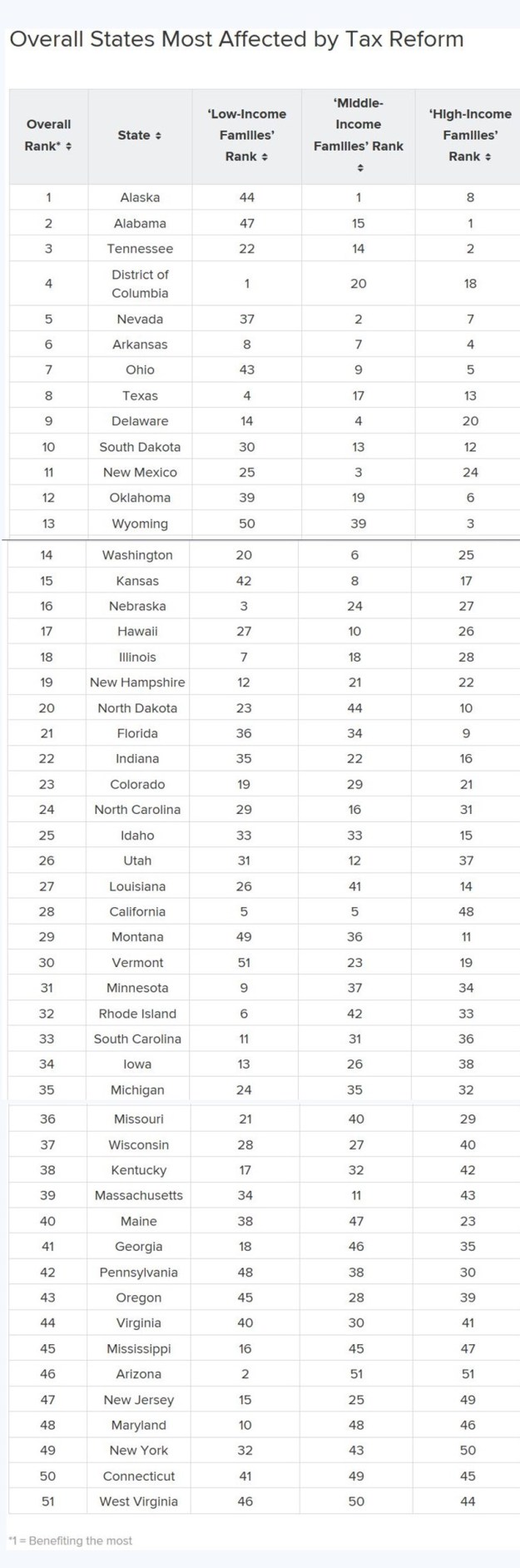
According to Adam McCann, writing for WalletHub:

“The law lowers the corporate income tax from 35 to 21 percent, and is projected to increase overall after-tax income in every quintile of taxpayers. However, some people aren’t confident the new rates will be beneficial for all. According to WalletHub’s Tax Survey, 69 percent of consumers say that they believe the new tax reform will benefit corporations more than consumers. And 67 percent believe it will favor the rich over the middle class. While the changes to the tax law won’t affect most Americans’ 2018 filings for the 2017 fiscal year, 2019 will be a much different story.

“Citizens of certain states will benefit more than others, too. In order to find out where taxpayers will get the best breaks, WalletHub compared the 50 states and the District of Columbia based on the state-specific average tax change for low, middle and high-income families. Below you’ll find the full ranking.” As well as a few more tailored charts beneath the table.”

Tax Law Effects by State
 
Tax Law's Effects by State

Source: WalletHub


Posted in Part 3: Targeting Customers and Gathering Information, Part 5: Managing a Retail Business, Part 6: Merchandise Management and Pricing, Part 8: Putting It All Together | Tagged , , , | Leave a comment

Customer Relationships in a High-Tech World

External customer relationships, post-purchase customer relationships, and internal company relationships are always vital. And so are customer relationships in a high-tech world.

But first, let’s explore “customer relationship” from a few sources:

  • Entrepreneur Magazine. Company relationships refer to “ways in which your firm communicates and deals with existing customers. To increase profits, it’s tempting to concentrate on new or bigger accounts. But attention to existing customers, no matter how small, is essential to thrive. The secret to repeat business? Follow up in a way that positively affects the customer.”
  • TechTarget Network. “Customer relationship management (CRM) refers to practices, strategies, and technologies that firms use. This can manage and analyze interactions in the customer lifecycle. With the goal of improving customer service relationships and assisting in customer retention and driving sales growth.
  • Investopedia. “From the firm’s viewpoint, the entire customer relationship encompasses direct interactions. Such as sales and service-related processes. As well as forecasting and analysis of customer trends and behaviors. Ultimately, CRM serves to enhance the customer’s overall experience.

As this Microsoft chart shows, the basis of CRM can be simple. [But implementation can be hard and time-consuming.]

Customer Relationships in a High-Tech World -- Three Basic Steps
 

Customer Relationships in a High-Tech World

Thanks to Steve Hashman and The CUBE for the following discussion and infographic.

“Technology can improve or disimprove relationships. And firms must be careful with how they enact it. Firms must keep in mind that 91% of consumers value authenticity. We know that sometimes technology can reduce this. Thus, the message in this CUBE infographic relates to how businesses must see technology as a way to get closer to customers rather than further away.”

“In addition, it’s imperative that technology doesn’t make firms life. And firms need to be careful about adopting every new technology. As the late Steve Jobs put it, ‘you’ve got to start with the customer experience and work backward to the technology’.”


Customer Relationships in a High-Tech World -- Infographic Tips


Posted in Part 2: Ownership, Strategy Mix, Online, Nontraditional, Part 3: Targeting Customers and Gathering Information, Part 7: Communicating with the Customer, Social Media and Retailing | Tagged , , , , , | Leave a comment