Fast Fashion Getting Faster

Today, numerous fashion marketers are following one very strong trend: fast fashion getting faster. And this represents a competitive advantage.

These prior posts also look at fashion activities:


Fast Fashion Getting Faster

Recently, McKinsey & Company did an in-depth study of fast fashion. Highlights of that report follow:

“To get new styles into stores quickly, fashion firms must improve internal collaboration. Tap into consumer insights. And start to digitize the value chain.”

“Burberry and Tom Ford began experimenting with “see now, buy now” in 2016. At that time, their efforts met with a little skepticism and a lot of excitement. The thinking? Consumers, especially millennials, have become accustomed to instant gratification. And much less willing to wait months to own the latest runway styles. “Fast fashion” firms — such as Forever 21, H&M, Inditex, and Primark — already made replicas of fresh-off-the-runway items. They sold them in stores in a matter of weeks. Thus, consumers rewarded their speed to market. As a result, revenues at those companies rose 8.2 percent in 2017 overall. But overall apparel retail grew only about 3.5 percent in that same period. With a see-now-buy-now sales model, luxury fashion companies, too, could capitalize on the media coverage. Including Fashion Week events in New York, London, Milan, and Paris, and translate the buzz into full-fledged sales campaigns.”


“Broadly speaking, the fashion cycle consists of three phases: planning, design, and product development; sell-in; and production and delivery. The length of each phase varies widely by company. A phase can be as short as 12 weeks or as long as 30.”
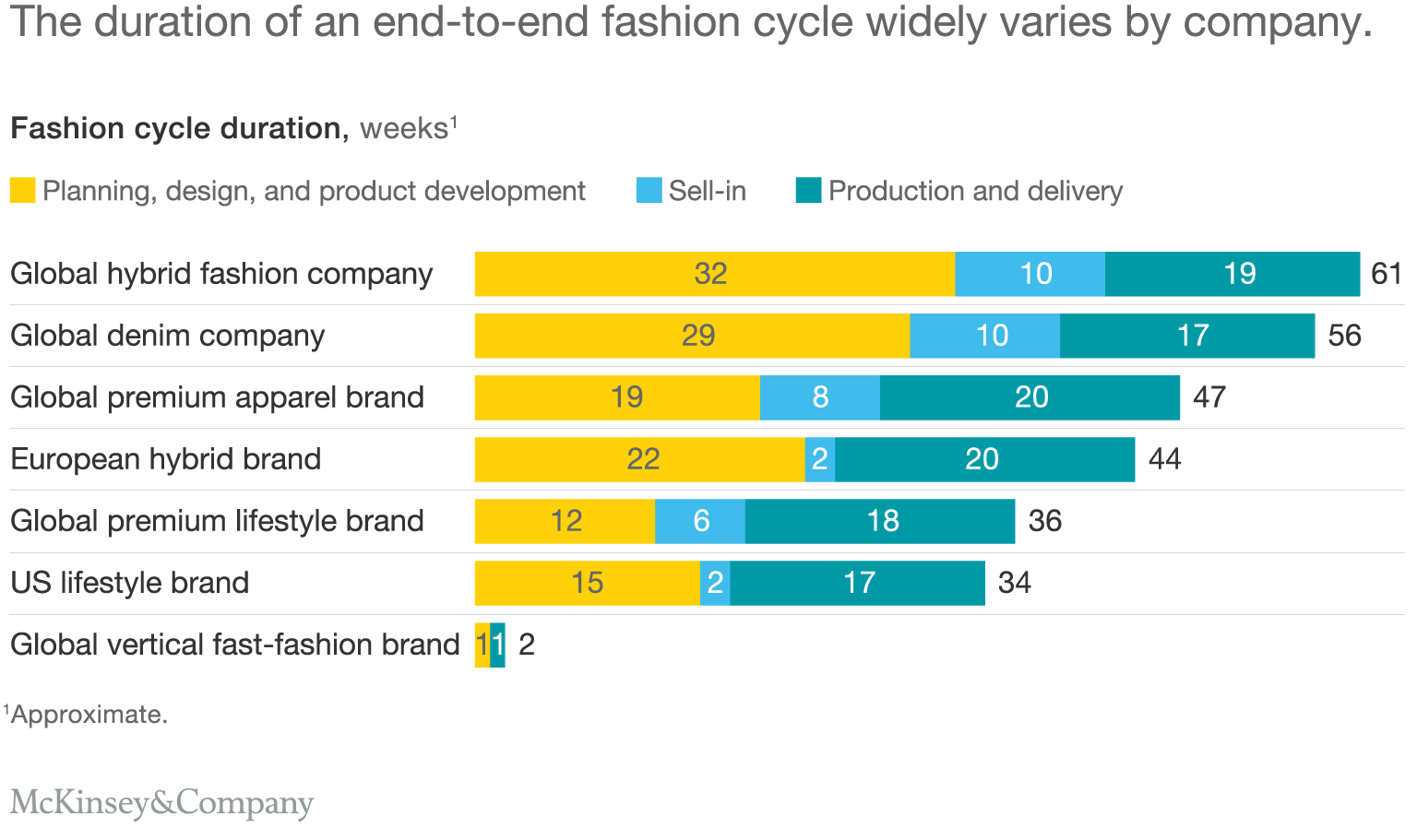
Fast Fashion Getting Faster -- Three Stages

Click here to read the full McKinsey report on speeding up the fashion cycle.

 

Posted in Global Retailing, Part 3: Targeting Customers and Gathering Information, Part 6: Merchandise Management and Pricing | Tagged , , , , , | Leave a comment

Smart Appliances Still Not Cutting It YET

Despite the huge hype surrounding them, smart appliances are still not cutting it yet. Shoppers have been in no hurry to buy.


Smart Appliances Still Not Cutting It YET

As Krista Garcia reports for eMarketer:

“Smart-home technology like connected TVs and lighting have been available for awhile. But smart appliances like refrigerators and dishwashers aren’t prevalent in U.S. homes. That could change, though.”

According to a January 2018 survey by Fluent LLC, many U.S. Internet users (55%) own some form of smart-home technology. The most common device is a smart TV (38%), followed by lighting (17%), thermostats (16%) and security systems (14%). Kitchen appliances had the lowest level of ownership (7%) among those mentioned.”

“In a June 2018 YouGov poll, 62% of U.S. consumers said they were aware of smart appliances (including thermostats, not just kitchen appliances) but didn’t really know much about them. This was more pronounced for those 35 and older (67%), while 52% of consumers ages 18 to 34 knew about smart appliances but didn’t fully understand them. Over one-quarter (26%) of that younger age group had awareness and claimed to know a lot about them. In all, just 9% of respondents across all age groups had not heard of smart appliances. “

“The biggest worry with smart appliances is cost: 31% of respondents ages 18 to 34 and 38% of those over 35 cited this as a concern. Being hacked and fears about data privacy had similar levels of concern, while practical matters like not being able to use them if there were problems connecting to the internet was also an issue. “

Smart Appliances Still Not Cutting It YET
 

Posted in Part 3: Targeting Customers and Gathering Information, Part 6: Merchandise Management and Pricing, Part 7: Communicating with the Customer | Tagged , , , , | 1 Comment

Value of Shoppers SECOND Purchases

 
Gaining and keeping customer loyalty remains a key goal for most firms. In general, loyal shoppers contribute to both higher revenues and higher profit. In today’s post, we examine the value of shoppers second purchases. Why? If we get customers to return at least once, chances increase for turning them into loyal shoppers.

First, consider these posts:


Understanding the Value of Shoppers SECOND Purchases

As Jacqueline Renfrow reports for FierceRetail:

“In general, firms know that a second purchase usually results in increasing a customer’s lifetime value. Still, some firms never get past the first purchase by providing follow-up communication. Many shoppers miss that follow-up contact. To learn more, marketing firm Bluecore examined post-purchase messaging to customers. 80% of respondents comprised first-time buyers. And they patronized 16 apparel firms. The findings: Second-time buyers become 130% more valuable. Also, customer value does continue to grow with each purchase. BUT the biggest jump in value happens between the first and second purchases.”

“In fact, many second transactions, about 60%, occur within 100 days of the first purchase. After that 100 days, the chances of a second purchase drop below 10%. But the research shows that even covering just 5% of these 80,000 one-time buyers could lead to $550,000 more in revenue over the next two years.”

Therefore, more firms need to focus on driving second customer purchases. They must be aggressive in doing so.

Click the image to read Renfrow’s full article for FierceRetail. How would YOU drive greater second purchases from first-time customers?

Value of Shoppers SECOND Purchases

“Marketers should focus on repeat buyers, not acquisitions.” (iStock/Rawpixel-Ltd)

Posted in Part 1: Overview/Planning, Part 2: Ownership, Strategy Mix, Online, Nontraditional, Part 3: Targeting Customers and Gathering Information, Part 7: Communicating with the Customer | Tagged , , , | Leave a comment